
It seems the only time I update this blog is when I have a book coming out. There are two reasons for this. The first is because I am not a natural blogger. These days I prefer to log my regular activities through social media; mostly Facebook and Instagram. It’s a daily habit that I find has more power than a blog. The second reason is because I’m normally too busy working on my project before it becomes a fully-fledged publication.
This project is a collaboration with my husband Colin, and it has taken us five years to complete. It began just as lockdown restrictions eased off a little. Something to take our minds off the pandemic; something to keep me writing at a time of low motivation. The research would be fun, and I reckoned if I could at least write a couple of poems or short stories, it would be better than nothing.
Here is the blurb from the back of the book.
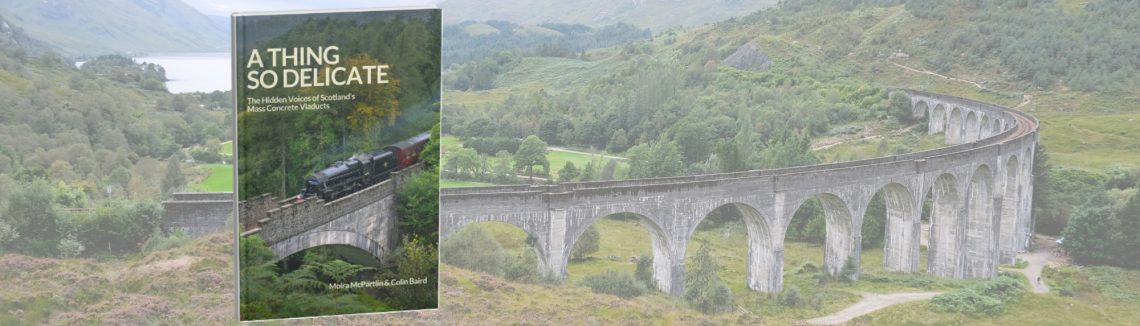
A chance finding on the way to the pub led to an unexpected adventure for author, Moira McPartlin and retired civil engineer, Colin Baird. As they crossed the footpath over the Dochart Viaduct, the second Mass Concrete Viaduct built in Scotland, Moira asked, ‘What’s mass concrete?’
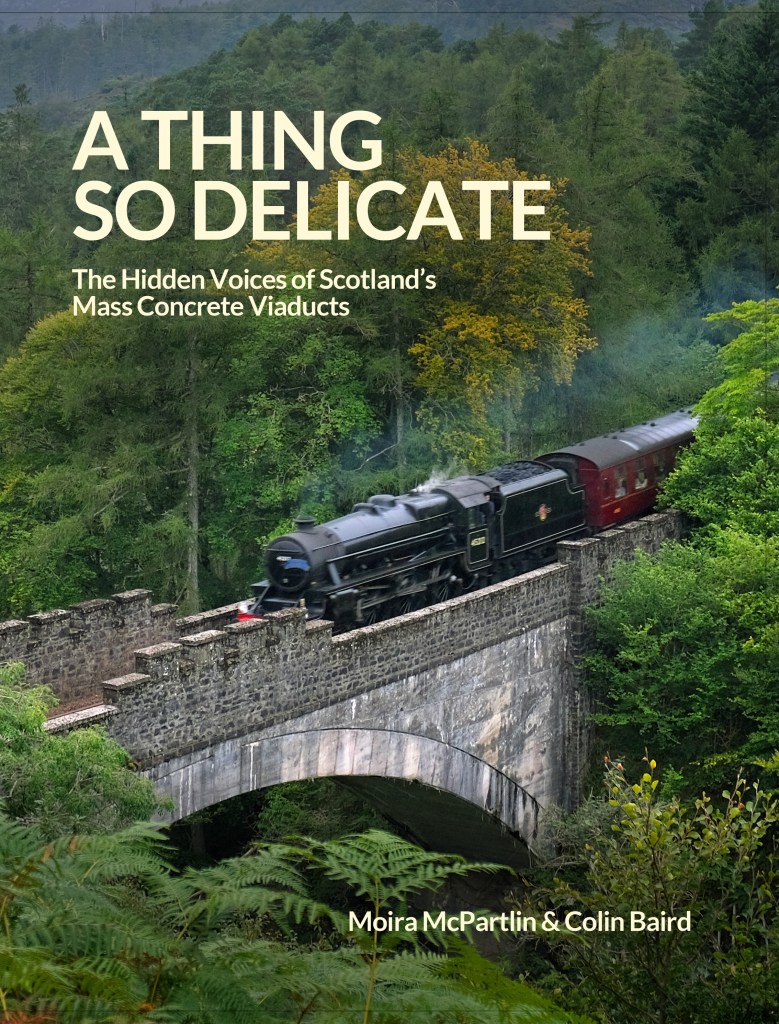
That question was the first of many that sparked the couple’s collaborative project, A Thing So Delicate:The Hidden Voices of Scotland’s Mass Concrete Viaducts.
Season adventurers, Moira and Colin, found twenty significant mass concrete viaducts built in Scotland between the years 1880 and 1904. What they discovered was not ugly industrial structures but carefully engineered elegant curves that blended into their environment. They asked the questions ‘Who built these?’ and ‘What are their stories?’ Not just stories of the men in the history books but the common men and women whose lives the bridges impacted.
As Moira and Colin travelled through Scotland in their campervan, they recorded their adventures to find these delicate creatures who have carried railways over a century of progress into modern day Scotland. Through a curated mix of history, memoir, poems, short stories, travel writing and photographs they have unlocked the hidden voices of Scotland’s mass concrete viaducts.
What began as a distraction soon became a passion. Our research methods were patchy to say the least but, with each bridge we uncovered, I let my imagination loose and this resulted in characters, situations and unique connections forming. We soon discovered that the established historical books had gaps or contradictions. I found the newspapers of the time filled with snippets of ordinary folk and also demonstrated the values and norms of the times; they all fell into the mix. Myths and legends also helped like the predictions of the Lady of Lawers and the healing stones of St Fillans.
Early on in the project I was warned by a fellow writer against trying to do too much with my wish to draw parallels with Victorians times and now. I should focus on the bridges other well wishers urged but I wanted this to be the story of people. As I read newspaper articles from the late 19th century about trouble in Ireland, war in Afghanistan, threats from Russia my resolve grew. Then I read more about the treatment of navvies, many immigrants from Ireland doing the work many locals perhaps didn’t want; or the NIMBYism of wealthy landowners. It seemed to me nothing had changed that much.
The fiction in ATSD is not all about concrete and engineering but it is connected to the bridges. The stories are a mix of historical and contemporary with the poems tackling a wide range of subjects including flora and fauna.
Colin helped with the research and technical information, but it should be stressed, this is not a technical book. We hope the facts we provide are enough to give the reader just enough to appreciate the splendour of mass concrete bridges.
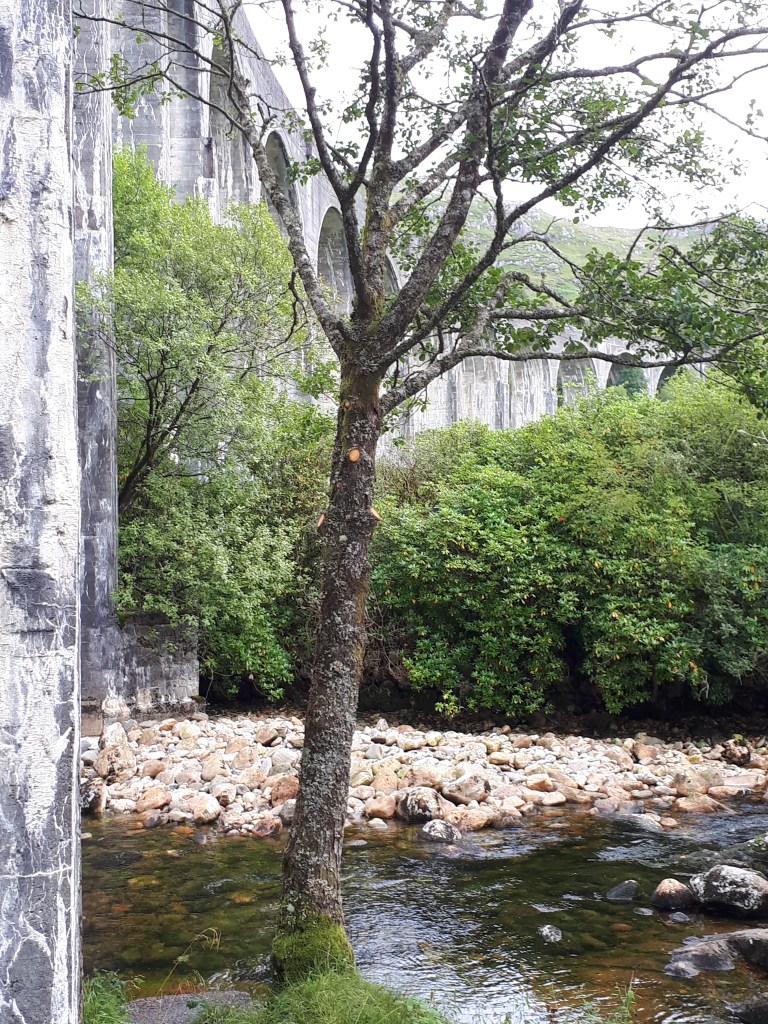
Colin’s main job was photographer. This was more of a challenge than we anticipated due to the remote nature of some of the bridges, the dense vegetation and the deep gorges they often crossed. But his perseverance paid off and the book is filled with stunning images of hard-to-find sites.
ATSD is for lay people, those who love Scotland’s landscape and who enjoy a good story.
We believe the selection that made the final cut are the most significant mass concrete viaduct in Scotland and will give an insight into their beauty and how well they blend into their environment. I personally hope ATSD will be used as a guidebook so that readers will venture out to find each bridge to experience it for themselves (as long as they leave no trace as we did).
You can order A Thing So Delicate here.


